
How a farming family is embracing farm life pace to face local challenges.
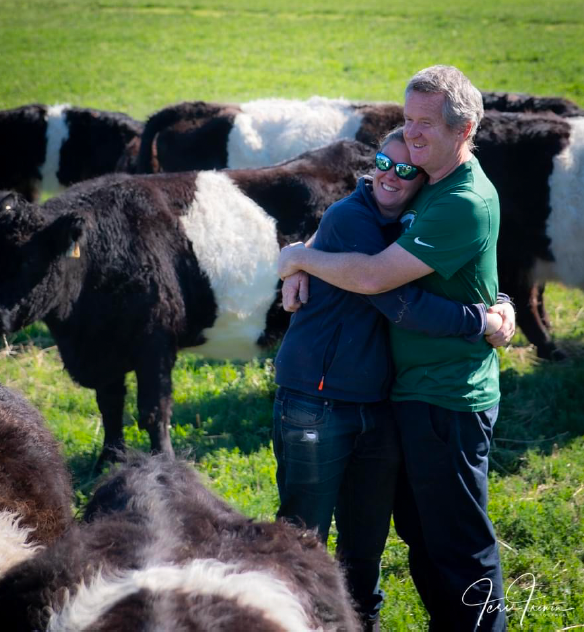
Zoe Holt pictured with her husband Ben surrounded by their Belted Galloway cows on their property
Along the Victorian Surf Coast, the weather is slowly growing warmer as spring comes in. The sun casts a warm glow over paddocks scattered with livestock gently feeding on patches of grass. Calves roam curiously between older members of the herd, the occasional mis-step prompting attention from the mothers in the group.
For stud farmer Zoe Holt, this is one of the “best times” of the year.
“Spring is kind of a hopeful time of year, everything starts coming to life,” she says.
After moving to Freshwater Creek 5 years ago, Zoe and her family have embraced the relaxed lifestyle the farm has to offer. That’s to say, life certainly does not come without its challenges as the family adapts to a change of pace.
“I think it’s the environment for me that helps to regulate, it’s a bit of a slower pace,” Zoe says.
Zoe spent her childhood growing up an hour outside of Melbourne in Avonsleigh, before moving abroad to London and then back to the inner-city suburb of Camberwell. Having the space to grow up without social judgment was vital to her upbringing and an important factor in her decision to make a regional move with her family, including her 10-year-old daughter.
“I didn’t want her to go to a big city school, didn’t want her to feel like she has to compare to everyone else socially,” Zoe says.
The days start early for the Holt family, the spring calving season sees the herd being checked two or sometimes three times a day to check if anyone has gone into labour. Then making sure there is enough feed. School drop offs and supermarket runs for the family, and a doctor’s appointment.
This is one of the harder parts of the daily routine for Zoe, who was diagnosed with breast cancer at the start of 2025, becoming one of the approximately 21,000 Australians diagnosed with the disease every year, and one of the 58 everyday.
With the loss of her mother when she was 19, the reality for Zoe set in when thinking about her own young daughter.
“It was pretty confronting, especially with a 10-year-old kid. It makes you re-evaluate where you’re at and what you’re doing,” she says. “You’ve got to think things through more and listen to your body. Everyone says that.”
With the cancer discovered at the “incredibly early” Stage 0, it took removal and radiation for Zoe to be on the path to recovery.
But the challenges for the year did not stop there.
The current drought climate that Victoria is experiencing has had a major impact on local farmers such as Zoe and her family. The Bureau of Meteorology observed from July to September 2025 rainfall was below average in the state as much as 20% below the 1961-1990 average. This is not to say there has been no rainfall at all, but just “not nearly enough” according to Zoe.
“Everything looks green but it’s not growing enough,” she says. “Economically, right at the moment, it’s not a great time to have stud cattle.”
But, Zoe and her family seem to be adjusting as farmers must.
“You just have to be able to roll with the punches, so when you can’t sell for looks you sell for produce,” Zoe says.
Zoe has also started to utilise regenerative farming, what she calls one of her “weird city ideas” to promote healthy soil and in turn healthy produce.
“Our approach is you need to look after soil, generate microbiology. We don’t use fertilizer or pesticides because I think there’s better ways of doing things,” she says.
While this new approach has been a positive idea to increase growth for the farm, Zoe notes it has not come without skepticism.
“Some farmers roll their eyes and just think it’s ridiculous, but I think part of that is they just control what they can control,” she says.
“It’s sometimes too risky to try something new.”
Uncertainty hangs in the air for the community as Zoe observes “all of the long term outlooks suggest it’s gonna get drier and drier” for the south-coast region as BoM forecasts “warmer than average days and nights” for the end of the year.
But, while it’s still Spring, it is hope that Zoe and her family will hold on to.
If this story or its themes have raised any concerns for you/you would like any further information, visit
http://www.mcgrathfoundation.com.au/ and/or agriculture.vic.gov.au/farm-management/drought-support
This story is part of a project exploring regional Victoria and the issues farmers are facing. See the whole collection here.
 Sophie Janusko